Serene


Tuesday, November 28, 2006

Annan writes to UNSC to assist in Nepal's peace process

The United Nations (UN) Secretary-General, Kofi Annan, has written a letter to the UN Security Council (UNSC) president with regard A press release issued by the UN information centre in Kathmandu said the Secretary General noted that the United Nations has been requested to monitor the arrangements of arms and armed personnel by providing qualified monitors supported by appropriate technical capacity.
“Assistance is also being sought in a variety of areas in the peace process with a view to creating an atmosphere conducive to free and fair elections for the Constituent Assembly,” the Secretary General wrote.
The Secretary-General added that it is his strong belief that the UN should respond positively, and outlines three immediate steps with which he intends to proceed, the statement added.
Sources said Annan has asked the UNSC president for a mandate to "immediately" deploy 60 personnel in Nepal to monitor the peace process. Other necessary deployment will be carried out on the basis of the field report from Nepal, informed sources said.
The UNSC is likely to hold an informal meeting anytime this week on the Nepal issue, said the source.
Annan's personal representative to assist Nepal peace process Ian Martin is in New York to brief the Secretary General about the ongoing peace process in Nepal. to the peace process in Nepal for immediate assistance on it.

Labels: ,

MOUNTAINEERING IN NEPAL

Out of the ten highest peaks in the world, eight, including the tallest peak Mt. Everest, lie in Nepal. No wonder Nepal is the favorite destination for mountaineers, with more than 600 expeditions trudging up the Himalaya each year.
SEASONS AND PERMITS: There are four mountaineering seasons: spring (March-May), summer (June-August), autumn (September-November) and winter (December-February). A total of 160 Himalayan peaks are open to mountaineers. Climbing permits are issued by the Ministry of Culture, Tourism & Civil Aviation (MoTA) for mountaineering peaks, and by the Nepal Moutaineering Association (NMA) for smaller peaks, known as trekking peaks, which range in altitude from 5,587 to 6,654 m.
The following documents have to be sent to MoTA, Mountaineering Division when applying for a climbing permit: completed application, endorsement of the National Alpine Club, short biographies of all the members of the expedition (with photograph and signature), map and/or photograph of the mountain indicating climbing route and approach route map. Enlistment of the expedition’s name does not require and fee, and it should not be paid before receiving the permit from the Ministry of Tourism.
Permits to climb the trekking peaks are issued by NMA on “first come first served” basis. It is necessary to appoint a government recognized trekking agency of Nepal as a liaison for the expedition Kathmandu. The trekking agency will look after all the requirements during the expedition.
FEE
A royalty (climbing fee) ranging from US$ 1,500 to US$ 10,000 (depending on the altitude of the peak) and US$ 50,000 for Everest is charged by MoTA for a group of seven persons. An additional US$ 20,000 is charged for the normal south east ridge route on Everest. An additional US$200 to US$ 1,500 per person (US$ 10,000 per person for Everest) will be charged if the group exceeds seven persons. The full amount of the royalty has to be paid within two months of the date of issue of the permit, otherwise it may be canceled. The royalty must be paid directly to MoCTCA by bank draft or bank transfer in convertible foreign currency only.
For trekking peaks, NMA charges a royalty of US$ 350 for a group of upto four persons. Each additional member for upto eight members is charged an extra
US$ 40. For a group exceeding eight members, NMA charges US$ 510 and US$ 25 per person for upto twelve members.
CONTACT
For further information, contact Ministry of Culture, Tourism & Civil Aviation, Tourism Industry Administration, Mountaineering Division, Bhrikuti Mandap, Kathmandu; Tel: 256234
Nepal Mountaineering Association: Naxal, Kathmandu; Tel: 0977-1-443425, 0977-1-4435442; Fax: 0977-1-4434578.
E-mail:
office@nepalmountaineeringassociation.com
Website: www.nepalmountaineeringassociation.com

Labels: ,

The Yak – Not just another Hairy Beast

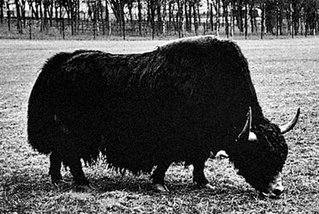
If you are fortunate enough to go trekking in the high Himalaya during your visit here, you will undoubtedly come across the yak. This shaggy beast, a sort of high-altitude cow, is the animal most often associated with the Himalaya. In mountain mythology yaks frequently served as messengers of the gods, but for Himalayan villagers, they are an indispensable part of daily life.
In the high Himalayan valleys, most people have served means of livelihood: farming, trading, and herding sheep and yaks. Originally, the yaks were a wild beast which roamed the Tibetan plateau. Particularly suited for high altitude living above 3000 meters, the yak is one of the mainstays of Himalayan life. Over the centuries they have been domesticated and sometimes cross-bred by the local population, but they remain shy creatures, wary of strangers and prone to erratic behavior.
Male yaks provide the major means of transporting goods in the high-altitude Himalaya and the Tibetan plateau. They can carry up to one hundred kilograms of cargo over precarious trails and snow-filled passes. In the mountains between Nepal and Tibet, long yak caravans are a common sight. The lead yaks are well trained animals who respond readily to their owner’s commands and know the trails without a faltering step-they can plow through four feet of unbroken snow. The respect given to the lead yak is shown by the lead yak is shown by the fact that it does not carry a load like the rest of the caravan and is adorned with bells and bright red tassels.
In these caravans, which can have up to fifty yaks or more, the main cargo brought from Tibet is rock salt, dried sheep meat, wool, saddle carpets, worked silver, and Chinese manufactured goods such as shoes, thermoses, flashlights, and tea cups. Often these traders sell their wares in the high valleys, but if they decide to trade at lower elevations, the loads are transferred from the yaks to mules and horses. Rice, tea, sugar, kerosene, and cloth are carried on the return trip.
The females, call dri or nak, are even more productive than the males for they give rich milk, essential to the diets of the mountain people. This milk is especially tasty because of the diet of high mountain herbs; the locals say the higher the dri grazes, the sweeter the milk. In mountain areas, where the variety of food is limited, the products derived from dri milk assume great importance. The people of this region drink more tea than anywhere else in the world, thirty to fifty cups a day. This tea is not what the foreigner would expect. It is made with milk, butter, and salt, blended in a tall wooden churn. It resembles a soup more than tea, and it fortifies the people against the cold. The milk of dris is also made into cheese and yoghurt. The cheese is dried in the sun or over an open fire to preserve it for the winter months when dairy products are scare. This is called chhurpi, a favorite snack of mountain people.
Both yaks and dris provide high quality wool, rich in lanolin and long of fiber. This creates a whole weaving industry of tents, blankets, ropes, and clothing. The meat of the animal is eaten fresh or more often, dried into jerky.
Yak herders are semi-nomadic people. They live in their own villages only during the cold winter months. Following the seasons and the grass, they move as often as six times a year. With the warm weather they move up the mountainsides, reaching the highest pastures in the summer. Some go up as high as 6000 meters.
The trekker will hike by and perhaps even camp in the high summer settlements of the yak herders. The construction of these settlements varies from place to place. Some are solid stone buildings, as found in Langtang, complete with hearths, shelves, and locking doors. Others, as in the Solu district, are simple bamboo dwellings which are moved with the herd from pasture to pasture. The herders and animals stay in the summer pastures from May to September. In this period the females give birth, thus increasing their capacity to produce milk. Half the daily milk is left for the young, while the herders take the rest for their own needs.
With the advent of autumn, the herds are slowly moved back down. Spring is a time of festivals for the departure of the herders from their homes to the pastures above. Summer is probably the favorite season because the weather is warm and the grass and milk plentiful. Fall brings much work, for the winter fodder must be cut, dried, and stored.
The number of yaks in a man’s herd represents his wealth. A yak is a substantial investment for the Himalaya dweller and an important piece of property. Yaks may live thirty years; their age is visible by the length of their horns. They make and produce milk between the ages of three and twenty-five. Young virile yaks often test their prowess in competitive battles over the females. These fights are fierce clashes, sometimes resulting in the loser falling over a cliff or into a gorge.
Yaks that have been crossbred with cows are called dzo (male) and dzomo (female). They can live at lower altitude and are easier to handle when carrying loads. The dzomo retains the fine milking characteristics of the dris. The visible difference between the two types of animals is very slight; dzos and dzomos are smaller and do not have the long shaggy hair falling from their flanks and sides as yak do.Listen for the tinkling of yak bells as you trek through the mountains, along the step trails and through high pastures. You are hearing the age-old sound of the messengers of gods, the sound of a way of life unique to the Himalaya.

Labels: ,

YETI -The abominable Snowman

There are plenty of anecdotes and stories of Yeti sightings by village people of the Himalayan regions of Tibet, Nepal and Sikkim. Yeti has also been sighted occasionally in the Pamirs and in the high mountains of Mongolia. Yogi Narharinath, a Nepalese historian, claims he saw the Himalayan “Abominable Snowman” in July 1968 while returning from a pilgrimage to the Mansarovar Lake in western Tibet.
Sensational news came from a small Sherpa village, Machermo, two days’ walk from Namche Bazaar, in July 1974. A 18 years old Sherpa girl, named Lakpa Doma said she had been attacked by a Yeti. The beast killed five of Lakpa Doma’s yaks by twisting their heads by the horns. The girl told that her attacker was darker in color, had shrunken eyes and black-brown hair covering its body. The police also investigated the case and found some footprints measuring 10.1 cm by 30.4 cm nearby. This is the only case of someone actually seeing a supposed Yeti in full view.
“I have one more ambition and it is to find the Snowman” said Sir Edmund Hillary in an address to Yeti-fans in New York after he made the first successful ascent in Mt. Everest. In 1960, he led an extensive search in Khumbu (the Everest region) and Arun Valley of northeastern Nepal for the Yeti. He returned with a scalp of a so called Yeti from the Khumjung monastery and took it to Chicago, London and Paris for laboratory testing. The scalp turned out to be nothing more than a 200-year-old artifact made from the hide of a Himalayan goat. Again, in the early 1970s another scalp from Pangboche monastery was examined in laboratories of Europe. Some examiners declared it a fake, but others, including a parapsychologist, said it was genuine.
The 1950s were the golden age for Yeti legends. Michael Peissel, the archaeologist and explorer, pointed out in 1961 that it was during the 1950s that special licenses (at Pound 400 per Yeti) were introduced by the Government of Nepal for Yeti hunters. An official tourist brochure of the period proclaimed that Nepal was the “land of Mount Everest and the Yeti.”
On April 28, 1988 just below base camp at 4585, John Paul Davidson, the BBC director, saw some tracks on the hillside above the Menlung Valley. He climbed up through the sonw to reach them and, as he got there, became conscious of a figure behind a rock above him. It was cloudy with flurries of snow, so he was unable to fully identify the figure, but reports that the creature he saw was very big indeed. It was a strange and frightening experience, and remains unexplained.
The Yeti was once designated as one of the protected mammals of Nepal. It was also included in the map of Nepalese mammals published by UNICEF and the Wildlife Conservation Section of the Nepal Government. In Kathmandu many hotels, restaurants, travel agents and numerous commercial establishments have adopted the legendary name of Yeti. It serves as the mascot of the Kingdom’s national airlines, Royal Nepal Airlines.
After so many years of searching and investigation, scientists have deduced a few hypotheses on the Yeti’s suspicious existence. One is that it might be the long-extinct giant orangutan of the Himalayan foothills, which survived by taking refuge in the once-remote reaches. If so, it is now probably on the verge of extinction. Another theory says that the animal could be a direct descendant of Peking man or Gigantopithecus of one million years BC. This ape-man could have evolved in obscurity in inhospitable habitats. Some hopeful Yeti advocates think of the Yeti in terms of “a missing link” in anthropology; others say that there is no fast evidence to substantiate a beast as the Yeti, and that the so-called Yeti footprints found in the snow are either of the Himalayan bear or the Tibetan Giant Panda. They staunchly claim that this seemingly elusive creature is the product of fantastic myth and fanciful legend.
Man has conquered the moon, but there are many mysteries on our earth still to be explored and explained. Among them Yeti, the snowman, is one. Ape, subhuman, wild snowman or demon – the myth of the Yeti, lives on. Perhaps someday the Yeti will be found as was the Spiny Babler of Nepal, the Cavemen of Kerala or China’s Giant Panda. Enthusiastic believers have not yet given up their hope of finding the Yeti.

Labels: ,

Government, Maoists sign arms management accord

After five days of hectic deliberations, the government and the Maoists signed a deal on management of arms and armies Tuesday evening.
Coordinator of the government’s talks team Home Minister Krishna Prasad Situala and Maoist chief negotiator Krishna Prasad Mahara signed the ‘Agreement on Monitoring of the Management of Arms and Armies’ amidst a news conference in Kathmandu.
A meeting of the representatives of the government, the CPN (Maoist) and United Nations finalised the modalities of management of arms and armies and the monitoring process.
They also settled contentious issues including the number of the arms to be kept by the Maoist People’s Liberation Army (PLA) for the security of its camps around the country and the issue whether military drillings should be allowed inside cantonments.
As per the agreement, the Maoists would be allowed to keep 30 arms for the security of each of the seven main camps and 15 arms for 21 satellite camps. The agreement has also ended the controversy over the categorization of the Maoist military, deciding to name the PLA structure simply as main camp and satellite camp.
The two sides have also agreed to form a nine-member Joint Monitoring Coordination Committee (JMCC) comprising three members from the Maoists, the government and the UN each, which will oversee the monitoring process.
The 12-page agreement paper says the PLA men would be allowed to conduct light military drillings inside the camps, without using of heavy fireworks, while the Nepal Army would be allowed to conduct its regular military exercises.
According to the agreement, up to 12 percent Maoist combatants would be allowed to take leave at a time. Regarding the verification of the combatants, those recruited prior to the signing of the ceasefire code of conduct (May 26), and those who reached 18 years of age by then, would be kept in the camps.
Addressing the news conference, Home Minister Situala described the agreement as a crucial development although it took some time to reach consensus. He informed that the draft of the agreement would be sent to the UN secretary general’s personal representative to Nepal, Ian Martin, for approval. He informed that 70 containers are being imported from India for storage of arms of the PLA and the Nepal Army.
The government and the Maoists had on November 21 agreed to lock of the arms of the Nepal Army equivalent to that of the PLA.
Similarly, Mahara, who is also the Maoist spokesperson, expressed confidence that the agreement would pave the way for political settlement. He also said the Maoists were committed to socio-economic transformation of the country.
Government and Maoist negotiators had held two rounds of meetings at Hotel Sangrila, Lazimpat, before finalising the accord.
Talking to reporters after the news conference, minister Pradeep Gyawali said the two sides have reached an agreement regarding the integration of the PLA men in the future National Army “based on accepted international norms”.
Home Minister Situala, government’s talks team members Gyawali and Ramesh Lekhak represented the government side in the marathon meeting that finalised the accord while Dr Baburam Bhattarai, Ram Bahadur Thapa ‘Badal’, talks coordinator Mahara and deputy commanders Pasang, Ananta, Baldev and Prabhakar represented the Maoist side.
Nepali Congress leader Dr Shekhar Koirala, UN’s John Norris and Jan Eric Wilhemson, Brigadier General of Nepal Army Shiva Ram Pradhan and AIG of Nepal Police Amar Singh Shah were also involved in the negotiations

Labels: ,

FACTS ABOUT NEPAL

Nepal is a kingdom of high Himalayan mountains, artistic monuments, exotic wildlife and diverse cultures. It is the land where Lord Buddha was born over 2,500 years ago. Roughly rectangular in shape, the kingdom of Nepal is situated between China to the north and India to the south. The land extends approximately 885 km east to west, and 193 km north to south. Nepal is primarily an agricultural country. Tourism, carpets and garments are the major industries.

THE LAND: The terrain rises from the Terai, the southern plains covered with tropical jungles and fertile farmland at almost sea level, to the high Himalaya mountains in the north with valleys and lush hills in between within a distance of less than 200 km. Eight of the ten highest peaks in the world lies in Nepal.

CLIMATE: Nepal contains a variety of climatic conditions ranging from the tropical heat of the Terai plains to the freezing cold of the high Himalaya. The mid-hills, particularly the Kathmandu Valley, are pleasant with warm summers and cool winters. Temperatures range between a maximum of 37 and a minimum of 8 degrees Celsius in the plains, 28 and 2 degrees Celsius in the mountains. The rainy season lasts from June to August.

Wildlife: Nepal provides shelters to over 30 species of large wild animals and approximately 180 species of mammals. The rhinoceros, tiger, crocodile, snow leopard, red panda, Himalayan black bear and many other beast are found in Nepal’s jungles. Nepal is also a haven for birds and over 800 species, representing approximately 10% of the world population, are found here. There are more than 650 species of butterflies and over 6,000 species of moths.

THE PEOPLE: Nepal’s many ethnic groups are as varied as its land with their own languages and cultures. In the Kathmandu Valley’s ethnic group are Newars; Bramins and Chhetris are scattered over the hills and valleys. The sherpas of the Himalaya are known as tough mountain climbers; and Tamangs are found in the districts around the Kathmandu Valley. The Rais, Limbus, Magars and Gurungs of the mid-hills have earned fame as Gurkha soldiers. Lowland ethnic groups such as the Maithili, Bhojpuria dn Tharu enchance the colorful mosaic. The population of Nepal is about 25 million.

LANGUAGE: Nepali, written in Devanagari script, is the national language as well as the lingua franca for Nepal’s diverse communities. Many languages and dialects are spoken in the kingdom, however, only six (Nepali, Bhojpuri, Tharu, Tamang and Nepalbhasa) are spoken by more than half a million people. English and Hindi are widely understood in the urban centers and places frequented by tourists.

CURRENCY: Nepalese currency is rupee (abbrev. Rs.) which is divided into 100 paisa. Bank note con in denomination of 1000, 500, 100, 50, 20, 10, 5, 2 and 1 rupees. Approximately exchange rate at this time is US$ 1 = Rs. 72.50

Labels: ,